Selling a house on the Outer Banks takes a specific approach to presentation. Buyers are scrolling through listing photos before they ever cross the Wright Memorial Bridge, and those first images carry real weight.
Getting a property ready here means dealing with salt wear, rental calendars, and flood zone rules. A clear plan for your time and budget before the photographer arrives helps protect your equity and avoid unnecessary delays.
Key takeaway
Start staging a Kitty Hawk home outside and on the main living level, and bring in a professional stager mainly when the home is vacant or furnished as a rental. Single-family homes here took a median 81 days to sell in the latest 90 days, so staging's job is to hold your price against competing listings, not spark a bidding war. On a tight budget, a deep clean, declutter, and deck repair come before rented furniture.
Who this guide is for
You're getting a Kitty Hawk home ready to list and deciding how much time and money to put into staging and what to tackle first.
What staging does in a slower Kitty Hawk market
Kitty Hawk single-family homes are currently taking a median 81 days to sell and closing at roughly 94.9% of the list price, based on 26 sales in the 90 days ending September 30, 2026. Prices are essentially flat, down a fractional 0.5% year over year (based on 26 single-family sales).
That makes staging a price-defense tool, not a way to force a bidding war. Because homes often close below asking and almost none go over, buyers will negotiate. Waiting around will not fix an overpriced or under-presented listing. For a home listed at $750,000, that sale-to-list ratio means closing around $711,750, a gap of about $38,250 below asking. Each percentage point of that gap equals $7,500. Set that math against a staging quote and the investment either makes sense or it doesn't.
Buyers meet the home through listing photos first. According to the National Association of Realtors, 97% of all homebuyers used the internet in their home search in 2020. The first money should go to the coastal wear buyers see in photos and on the way in, before any rented furniture.
To see what time costs, add up one month of carrying expenses: your mortgage, property tax, insurance, utilities, and any HOA dues. Compare that carrying cost against a cash offer, or review how long it takes to sell in Kitty Hawk to set your timeline. You can check your property tax bill and utility rules as you calculate those monthly numbers.
How to decide what to stage first
Before moving furniture, figure out the scope of the project. Your timeline and budget depend on who has access to the house and what furniture is already inside.
You can narrow down your staging plan by answering four questions:
- Is the home vacant, furnished for vacation rentals, or still lived in? Go to the section on staging a rental, an occupied home, or a vacant property.
- Do the deck, railings, outdoor shower, or ground-level entry show salt, sun, or storm wear? Fix the coastal wear buyers notice first before buying or renting any furniture.
- Will your list price sit above the single-family median of roughly $710,000? Read the section on professional stagers and compare a quote with the worked example in the first section.
- Do you plan to stage a den, loft, or ground-level room as a bedroom? Read the bedrooms and bathrooms section and check your septic permit first.
Fix the coastal wear buyers notice first
On the Outer Banks, the exterior and the entryway are the first photos a buyer sees and the first steps they take on the property. These spaces set the tone before anyone opens the front door.
Staging can dress up wear; it cannot hide defects. A loose railing or soft boards is a repair, and known problems belong on the disclosure form. You can handle repairs and upgrades before selling and fill out seller disclosures to manage structural issues correctly.
Exterior, decks, and outdoor showers
Salt air and sun show up first on decking, railings, hardware, and outdoor showers. Power-wash the deck, swap popped or gray boards, replace rusted fixtures, and clean the outdoor shower.
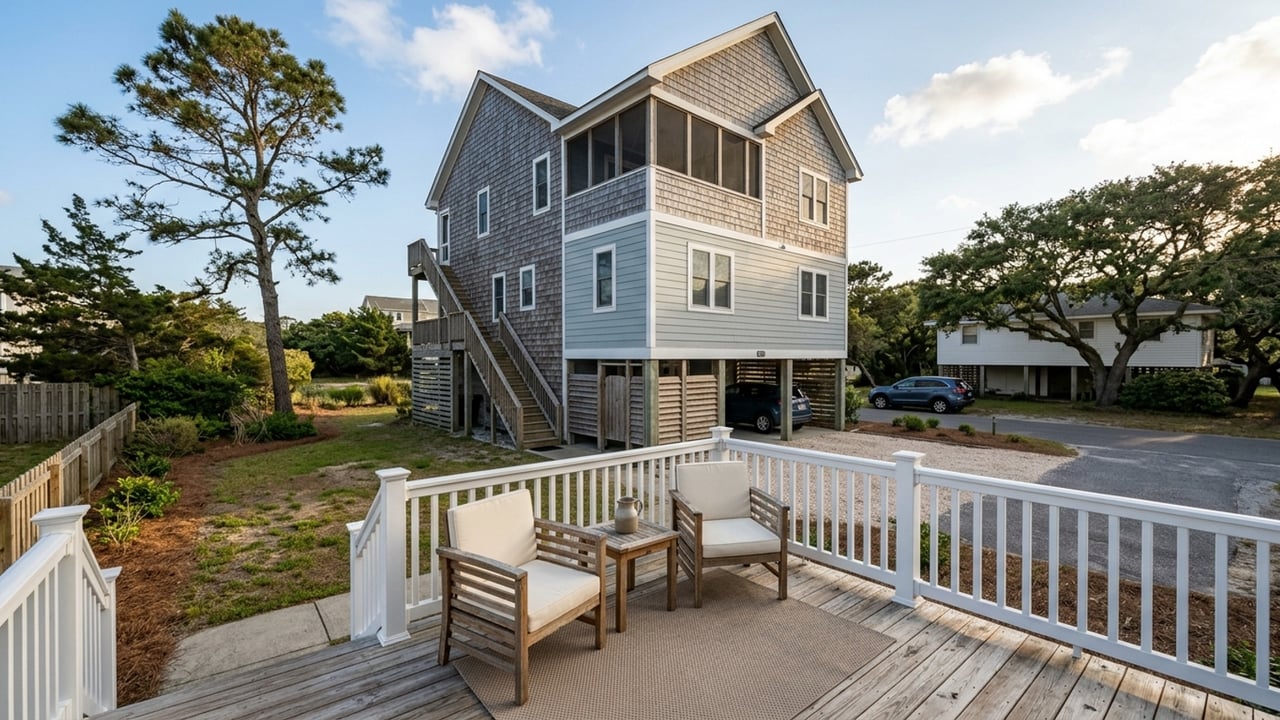
Stage the deck with two chairs and a small table so buyers read it as living space. Order matters here: this is often the hero photo and the first thing a buyer touches during a showing.
Ground-level entry and storage
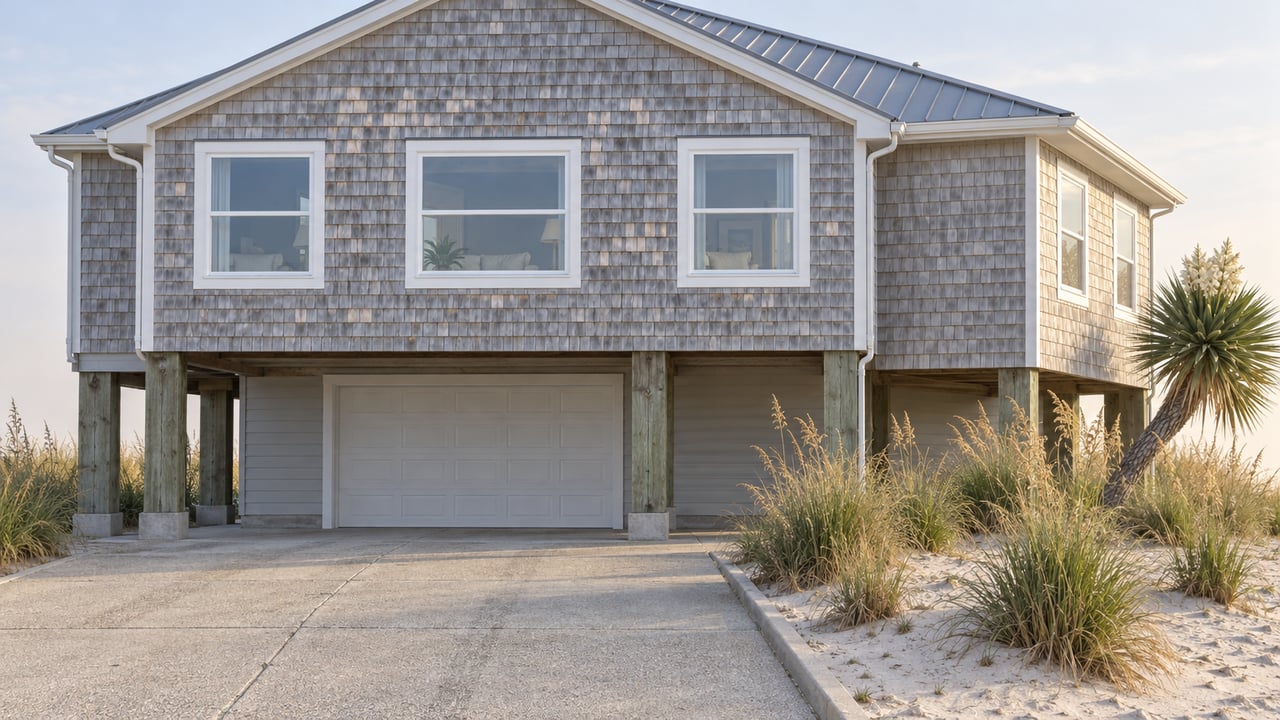
If the home sits on pilings or has a ground-level garage or storage area, the entry there is the first space a buyer steps into. Clear out beach gear, bikes, and kayaks. Light the space and make the path to the stairs obvious. Keep it to one tidy, organized storage zone so the first impression isn't clutter.
Don't stage a ground-level enclosure as living space unless its use is permitted. In flood zones, enclosed space below the base flood elevation is generally limited to parking, building access, and storage, so staging it as a bedroom or den can mislead buyers. Under NFIP regulations, storage is limited to items incidental to the structure's principal use, like lawn equipment.
Confirm the permitted use of any ground-level enclosed space with the Town of Kitty Hawk. The town's floodplain management ordinance states that enclosed spaces below the regulatory flood protection elevation must not be designed for human habitation. You can check how flood zones impact pricing to see how elevation affects value.
Stage the rooms that sell the listing
Once the exterior is clean, focus your effort on the spaces that drive the listing photos and the buyer's decision. The main living level carries the photography, while bedrooms carry the count buyers filter on.
You can't fully stage for both an owner-occupant and a rental buyer at the same time. Pick a direction based on your target buyer and stick to it throughout the house.
Main living level
Treat the kitchen, living, and dining area as one photographed space. If the home has living areas upstairs, that floor carries the listing. Turn furniture toward windows and any water or dune view.
Clear counters down to one or two items, use neutral textiles, and open the blinds. Swap dim bulbs so photos are bright. If the kitchen is small, remove extra appliances and stools to widen the work area.
Frame the room's light and flow honestly and let buyers discover the view, rather than pointing every chair at a sliver of water. Staging that oversells a partial or distant view backfires at the showing.
Bedrooms and bathrooms
Buyers filter by bedroom count, and some weigh sleeping capacity for rental use. Make beds simply: a neutral duvet, two sleeping pillows, and at most one accent pillow. Remove extra rental-style beds that crowd a room. Clear bathroom counters and swap mismatched towels for one matching set.
Staging a loft or den as a bedroom can backfire if the septic permit doesn't support the count. In Dare County, the number of bedrooms a home can be marketed with is tied to its septic permit. Pull your septic permit and confirm the bedroom count before staging or marketing an extra room as a bedroom.
Staging a rental, an occupied home, or a vacant property
Kitty Hawk sellers usually face one of three situations, and each comes with different constraints. A home with active guest bookings requires coordination, an occupied home requires daily editing, and a vacant home requires furniture.
The strategy changes depending on who has access to the house and what furnishings are already inside.
Homes in a vacation rental program
Clear out what signals a rental before photos: house-rules binders, lockbox and Wi-Fi signs, rental-company branded decor, and mismatched furniture sets.
Work with the property manager to block a few nights for deep cleaning and photography, and set showing windows between guest stays. Review your rental management agreement for showing access, blocked photo dates, and how future bookings are handled at closing.
Guest bookings limit when buyers can see the home, and existing reservations may need to be honored or transferred at closing. You can review rental investment performance for buyers who will ask about income.
Homes you still live in
Pack early, since you're moving anyway. Box up off-season clothes, extra kitchenware, and family photos. Then build a 15-minute daily reset routine: clear counters, make beds, sweep sand at the door, hide pet items, take out the trash.
Lived-in homes need less furniture and more editing. Living in a staged house for what could be several months is tiring, and one rushed showing in a messy house can undo the photos. Plan storage and a pet plan before going live. If the home is in an HOA, ask about rules on exterior decor, deck furniture, and signs.
Vacant homes and virtual staging
Empty rooms photograph smaller and colder, and buyers struggle to judge furniture fit. You have two options: physical staging of the main living level and primary bedroom, or virtual staging of listing photos when the budget is tight.
Buyers who fell for virtual furniture walk into empty rooms, and the gap can feel like a bait-and-switch. Consider staging at least the main living space in person.
Ask your listing agent how MLS rules require virtually staged photos to be labeled. The North Carolina Real Estate Commission considers virtual staging permissible as long as the advertising is not misleading and includes proper disclosure that images have been altered.
Hiring a professional stager versus doing it yourself
With 35 single-family homes currently on the market, buyers are comparing listings side by side. A staging professional earns their fee most often on empty properties, active vacation rentals, and listings priced over the roughly $710,000 single-family median. At that price point, a single percentage of the list price is a large dollar figure, as the worked example above shows.
Doing it yourself covers cleaning, decluttering, touch-up paint, exterior and deck work, and bedding. If you choose to hire out, get two or three written staging quotes that spell out the initial fee, the rental period, the monthly extension charge, delivery and removal, and who insures the furniture.
If you need specific home staging tips in Kitty Hawk, NC, Cameron Griggs Real Estate can walk through the home and suggest what to stage first based on the current market.
Getting your Kitty Hawk home ready to list
The order of operations matters. Complete repairs first, then stage the home, then take photos, then list the property. Skipping ahead on any of those steps tends to show. A clear checklist to sell my home in Kitty Hawk keeps these tasks organized.
You can review seller closing costs and real estate commissions as you prepare. Cameron Griggs Real Estate can help you sequence these steps correctly and get your property on the market.
Kitty Hawk seller market at a glance
Here's a snapshot of the local market based on recent sales. All figures rest on fewer than 30 sales, so treat them as a rough guide. You can review housing market trends for a broader look.
- Median sale price, single-family: $709,717, down 0.5% year over year (90 days ending Sept. 30, 2026; based on 26 sales, so treat as a rough guide)
- Median sale price, all homes: $692,170, up 7.3% year over year (90 days ending Sept. 30, 2026; based on 28 sales; the gap from single-family rests on about 2 other sales and is not a trend)
- Median days on market: 81 for single-family, 79 for all homes (90 days ending Sept. 30, 2026; 26 and 28 sales)
- Sale-to-list ratio: 94.9% for single-family, 95.2% for all homes (90 days ending Sept. 30, 2026; 26 and 28 sales)
- Share sold above list price: 3.9% of single-family, 3.6% of all homes (90 days ending Sept. 30, 2026; 26 and 28 sales)
- Months of supply: 4.1 for single-family, 4.6 for all homes (90 days ending Sept. 30, 2026)
- Active inventory: 35 single-family homes, 43 homes of all types (90 days ending Sept. 30, 2026)
- Median price per square foot: $348 for single-family, $355 for all homes (90 days ending Sept. 30, 2026; 26 and 28 sales)
Kitty Hawk home staging FAQs
Does staging a home help it sell in Kitty Hawk?
Yes, it generally helps buyers picture themselves living there. In the National Association of Realtors' 2025 Profile of Home Staging, 83% of buyers' agents said staging made it easier for a buyer to envision the property as their future home. There is no Kitty Hawk-specific staging study, but staging here is primarily a tool to defend your list price against the area's low sale-to-list ratio.
How much does it cost to stage a 4-bedroom home in Kitty Hawk?
There's no published local figure, but national averages provide a baseline. According to HomeAdvisor's 2025 cost data, homeowners spend an average of $1,849 on home staging nationally, with most projects ranging from $832 to $2,927. Get two or three written quotes and ask how the size, the number of rooms staged, and the rental period change the price.
Do homeowners get to keep the staging furniture?
No, staging furniture is normally the stager's inventory and leaves after the sale or when the rental period ends. Read your stager's contract to check removal timing and any option to buy pieces. If a buyer asks to keep staged items, that needs to be written into the purchase contract and cleared with the stager.
How far ahead of listing should I stage my house?
Schedule staging so it's finished before listing photos, since photos lock in the first impression. Ask stagers for current lead times on consultations and delivery, and coordinate with any repairs or blocked booking dates for rental homes. Don't assume a fixed week count unless a stager's quote supplies it.
Who are the home stagers serving Kitty Hawk?
You can search the Real Estate Staging Association (RESA) official member directory, which includes a dedicated North Carolina category to find professionals. Review portfolios of coastal homes, confirm their insurance, and ask about furniture rental terms. You should also ask your listing agent for stagers they've worked with locally.
Does hurricane season affect when I should stage and list in Kitty Hawk?
It can affect the timing of a buyer's closing, which impacts how long you rent staging furniture. According to NOAA, the official Atlantic hurricane season runs from June 1 to November 30. Under state rules, insurers may pause new policies when a named storm is in specified Atlantic basin coordinates, so ask your insurance agent about binding rules and make sure deck staging can be brought inside quickly.
Sources
- Redfin: Data Center
- NAR: 2021 Real Estate in a Digital Age
- NAR: Report Reveals Home Staging Boosts Sale Prices and Reduces Time on Market
- HomeAdvisor: How Much Does Home Staging Cost?
- FEMA: Storage
- Municode: Kitty Hawk Flood Damage Prevention Ordinance
- NC REALTORS: Is virtual staging legal in North Carolina?
- Real Estate Staging Association: Find a Professional Home Stager
- NOAA: Tropical Cyclone Climatology
- NCJUA/NCIUA: Restrictions Archive