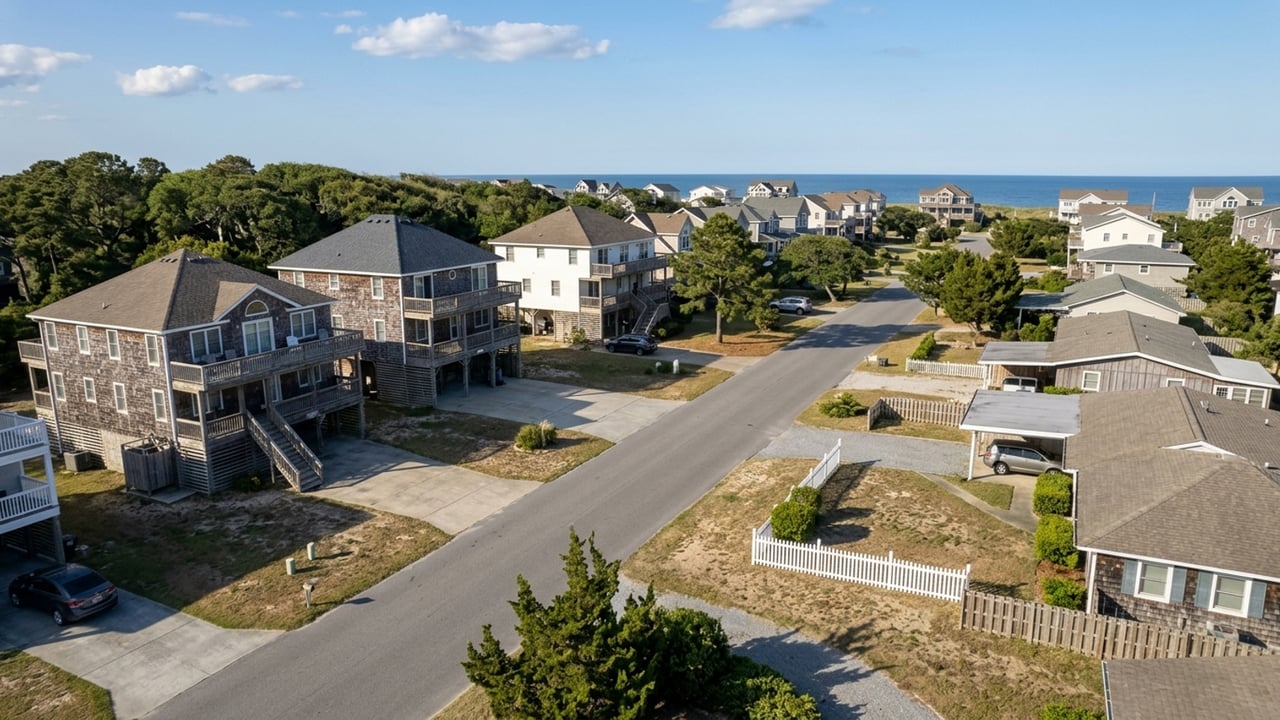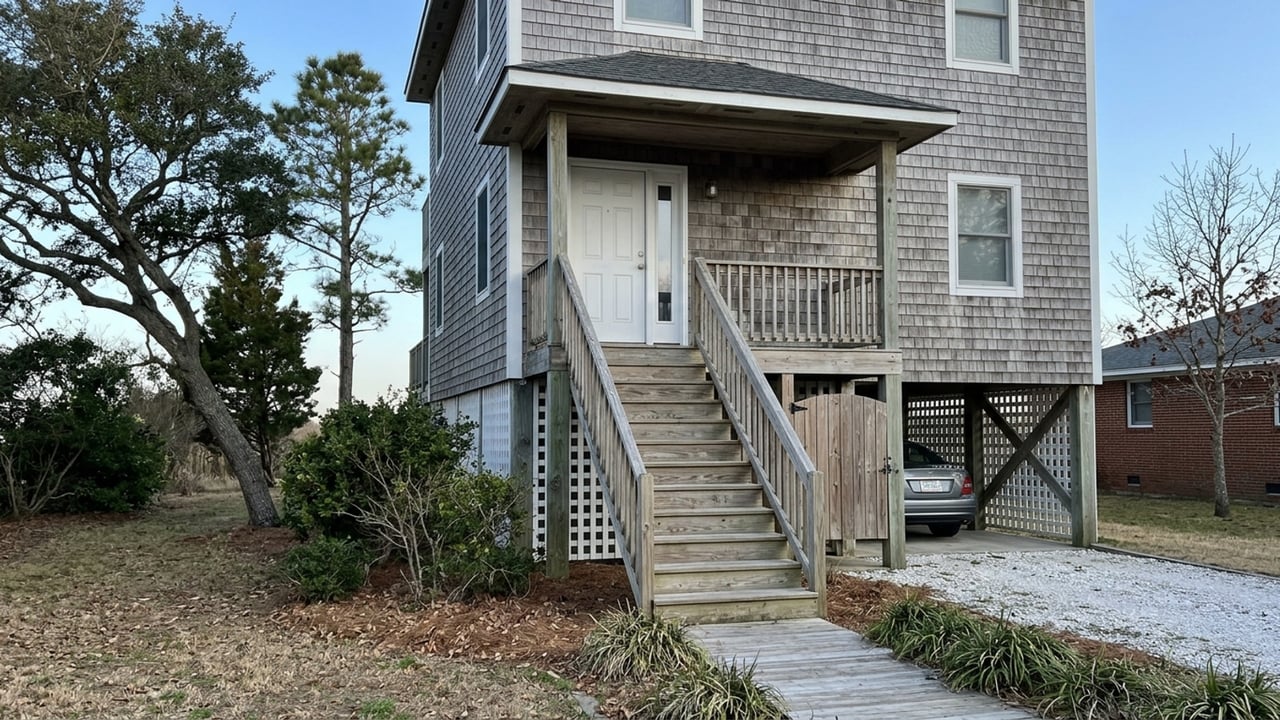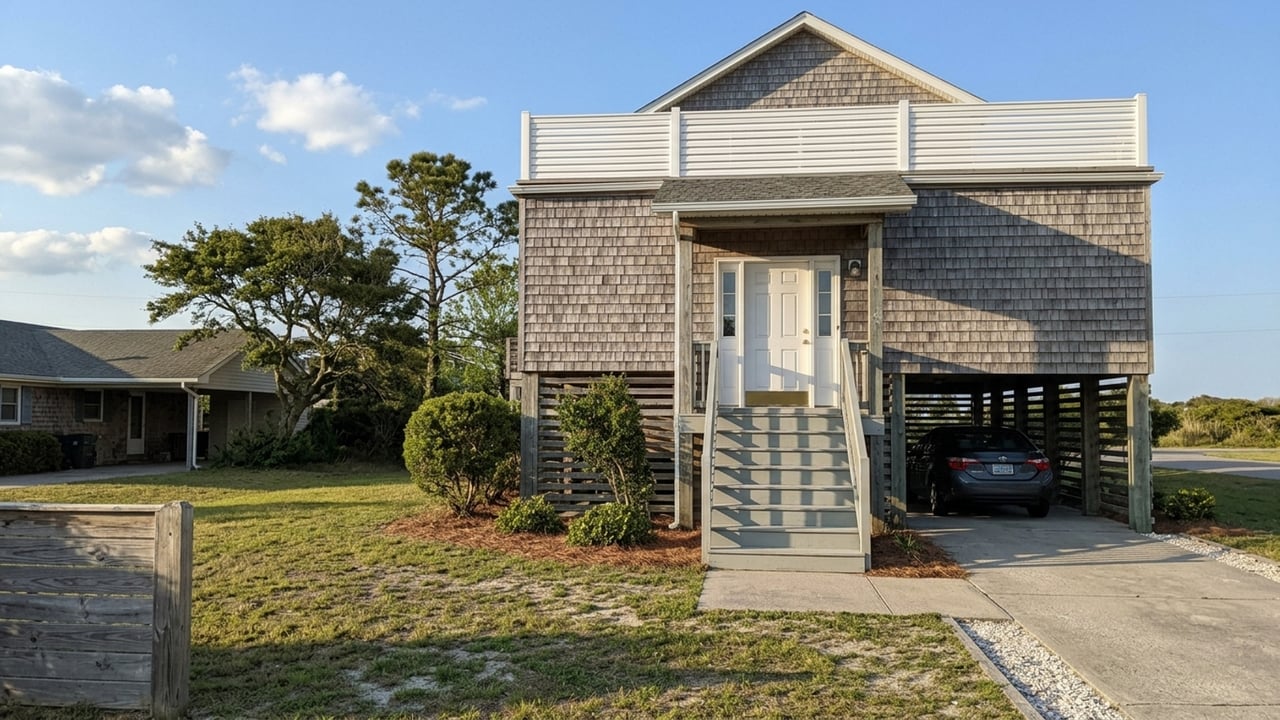
Kill Devil Hills sits right in the middle of the Outer Banks, splitting the difference between Kitty Hawk to the north and Nags Head to the south. Miles of shoreline on one side, the practical realities of barrier-island ownership on the other.
Key takeaway
Kill Devil Hills is worth a serious look in 2026 if you want a central Outer Banks beach town and can budget for coastal insurance. Single-family prices in the metro area have fallen from a year ago, which gives you room to negotiate. If being closer to Jockey's Ridge and the area's hospital matters more, compare Nags Head next door before you commit.
Who this guide is for
You're deciding whether to move to or buy a home in Kill Devil Hills and want to know whether this year's softer prices outweigh the storm, insurance, and tourist-season costs that come with living there.
Kill Devil Hills housing market outlook
Price is moving in buyers' favor in Kill Devil Hills. The costs that should decide your move are the ones a lower price can't fix: storm exposure, insurance, and a summer-rental economy.
The metro area's single-family median sale price sits at roughly $675,881, down 6.8% from a year ago, so sellers are no longer pricing off last year's highs. Homes are selling at 96.2% of their list price after a median 69 days on the market. That pace leaves time for insurance quotes and inspections before you commit. With 5.9 months of supply and only 6.4% of homes selling above asking, bidding wars are rare and offers below list are normal.
For illustration only: on a home listed at $700,000, that median ratio implies a sale near $673,400, or about $26,600 under asking.
These figures cover the broader Kill Devil Hills metro area. Condo and townhome sales were too few to break out reliably, so ask for town-only and condo comparable sales on your target street. Cameron Griggs Real Estate can pull recent comparable sales to help you evaluate specific properties.
Pros of living in Kill Devil Hills
According to the town's official beach page, Kill Devil Hills maintains numerous public beach accesses with varying amenities. Hayman Boulevard offers paved parking, accessible parking, a lifeguard, a porta-john and showers. Arch, Helga, Chowan, Walker, Eden, Fourth and Fifth Streets give neighborhoods direct routes to the water.
The town is also where Orville and Wilbur Wright made the first controlled, powered flight on December 17, 1903. The Wright Brothers National Memorial commemorates the flight.
Year-round residents are served by Dare County Schools. The district's address lookup confirms school assignment for a specific home.
Cons of living in Kill Devil Hills
The trade-offs here center on the physical environment and the seasonal economy. Extreme weather, high carrying costs, and heavy summer traffic are built into the address.
Hurricane and flood exposure
Kill Devil Hills sits on a barrier island, so storms are a certainty of ownership, not an occasional risk. Dare County uses two evacuation zones, and Kill Devil Hills is in Zone B.
After a mandatory evacuation, permanent residents can return by showing a valid NC driver's license with a Dare County address. Non-residents need a current Dare County-issued re-entry permit; prior-year permits aren't accepted, and none are issued within 72 hours of a storm's expected landfall.
The town has five flood zones, each carrying a different level of risk. Look up each address on the FEMA Flood Map Service Center and ask the seller for an elevation certificate if one exists.
Evacuation orders can come during peak season. You can be held off the island until re-entry is allowed, regardless of what's happening to your home.
Insurance and carrying costs
Plan to carry flood insurance through the National Flood Insurance Program plus wind/hail coverage. For Outer Banks properties, the North Carolina Insurance Underwriting Association provides windstorm and hail coverage through its Coastal Property Insurance Pool.
Get flood and wind/hail quotes for the specific property before you make an offer. Confirm the current property tax rate with the Dare County Tax Department and check short-term rental rules with the town planning department. Ask the seller for the roof's age and any storm-damage or insurance-claim history.
A seller's price cut doesn't lower your premiums. The recurring cost of coastal insurance can erase what you negotiated within a few years.
Summer crowds and a rental-driven economy
Dare County has a year-round population of about 37,000. The summer tourism industry pushes the daily average to between 225,000 and 300,000 from June through August. Traffic on US 158 and NC 12 slows, and many nearby homes operate as high-turnover vacation rentals.
Visit in the off-season to see which businesses and services keep year-round hours. If you plan to live near rentals, read any HOA or deed restrictions carefully.
Seasonality cuts both ways. Summer brings congestion and rental turnover next door, and the off-season can mean reduced hours at your usual stops.
Kill Devil Hills vs Nags Head
Nags Head, the town's immediate southern neighbor, shares the same hurricane risk, insurance exposure and barrier-island geography. The choice comes down to location and which amenities you want closer to your driveway.
Nags Head is home to Jockey's Ridge State Park and The Outer Banks Hospital. Kill Devil Hills hosts the Wright Brothers National Memorial and sits slightly closer to the mainland bridge in Kitty Hawk. Compare recent sales of similar homes in each town directly to see how prices stack up street by street.
How to decide if Kill Devil Hills fits your plans
The decision comes down to your budget for recurring costs and your tolerance for seasonal shifts. Ask yourself four questions:
- Can you carry flood and wind insurance plus storm prep on top of the purchase price, year after year? If you're unsure, read "Insurance and carrying costs" and "Hurricane and flood exposure" first.
- Will summer crowds, rental-heavy streets, and US 158 traffic wear on you, or do you mostly want off-season quiet? See "Summer crowds and a rental-driven economy."
- Are you ready to buy within the next few months and negotiate below asking? See "Kill Devil Hills housing market outlook" for how much room the numbers suggest.
- Do you need to be closer to Jockey's Ridge, the hospital, or Nags Head's amenities? See "Kill Devil Hills vs Nags Head."
Your starting point depends on what matters most:
- If you want room to negotiate on a detached house, start with Kill Devil Hills single-family listings that have sat longer than the 69-day median.
- If you want to keep insurance costs predictable, start with a FEMA flood map lookup and insurance quotes on each address before you shortlist.
- If you want to be closer to Jockey's Ridge and the area's hospital, start with Nags Head, then compare recent sales of similar homes against Kill Devil Hills.
Cameron Griggs Real Estate can pull comparable sales and flag listings past the median days on market.
At a glance
- Median sale price, single-family: $675,881 (Kill Devil Hills metro area, 30 days ending Sept. 30, 2026)
- Median sale price, all homes: $658,488 (metro area, 30 days ending Sept. 30, 2026)
- Year-over-year change in median sale price: -6.8% single-family, -1.2% all homes (30 days ending Sept. 30, 2026)
- Homes sold: 96 single-family, 108 all homes (30 days ending Sept. 30, 2026)
- Median days on market: 69 single-family, 71 all homes (30 days ending Sept. 30, 2026)
- Sale-to-list ratio: 96.2% single-family, 96.3% all homes (30 days ending Sept. 30, 2026)
- Share sold above list price: 6.4% single-family, 5.7% all homes (30 days ending Sept. 30, 2026)
- Months of supply: 5.9 single-family, 6.4 all homes (30 days ending Sept. 30, 2026)
- Homes for sale (inventory): 569 single-family, 693 all homes (30 days ending Sept. 30, 2026)
- Median price per square foot: $360 single-family, $359 all homes (30 days ending Sept. 30, 2026)
Living in Kill Devil Hills FAQs
Is Kill Devil Hills a good place to live?
It suits you if you want a central beach location and can absorb coastal storm and insurance costs. All homes in the metro area show 6.4 months of supply (30 days ending Sept. 30, 2026), which favors buyers.
What is the crime rate in Kill Devil Hills, NC?
The FBI publishes official statistics for the Kill Devil Hills Police Department monthly on its Crime Data Explorer, through the Uniform Crime Reporting Program. Per-resident rates on aggregator sites often don't account for the large seasonal visitor population.
Why is the town named Kill Devil Hills?
The town's official history page cites competing legends. In one, ships carrying tropical rum wrecked along the Outer Banks, washing liquor strong enough to "kill the devil" onto the sand hills. In another, a man trapped the devil in a pit atop the large hill where the Wright Brothers Monument now stands.
Can you drink alcohol on the beach in Kill Devil Hills?
Town code prohibits open containers of alcohol on listed town property. Unopened drinks in coolers or vehicles are allowed at listed parks and parking areas. Glass bottles and containers are prohibited on the beach area.
How far is Nags Head from Kill Devil Hills?
The two towns border each other, so drive time depends on where you start and finish. US 158 and NC 12 connect the town centers, and summer traffic slows both routes.
What is the average home price in Kill Devil Hills?
For the 30 days ending Sept. 30, 2026, the metro-area median sale price for all homes was $658,488, down 1.2% year over year. The median price was $359 per square foot.
What salary do you need to live in Kill Devil Hills?
The MIT Living Wage Calculator (2026 data) lists a living wage of $23.16 per hour in Dare County for one adult with no children working full-time. That rises to $40.05 for one adult with one child and $62.11 for one adult with three children.
What is the weather like in Kill Devil Hills by month?
Based on NOAA and National Weather Service data, daily mean temperatures range from about 44.7°F in January to 79.8°F in July, with an annual average daily mean of 62.3°F. The Atlantic hurricane season runs from June 1 to November 30.
Sources
- Redfin: Data Center
- National Park Service: First Flight
- Town of Kill Devil Hills: History
- Town of Kill Devil Hills: Beach Access
- Kill Devil Hills Code of Ordinances
- Town of Kill Devil Hills: Flood Information
- North Carolina Insurance Underwriting Association
- Dare County Emergency Management: Reentry
- FBI: Crime Data Explorer
- Dare County Schools: Attendance Zones
- NOAA: Climate Normals
- Dare County: About
- MIT Living Wage Calculator: Dare County
- North Carolina State Parks: Jockey's Ridge
- The Outer Banks Hospital