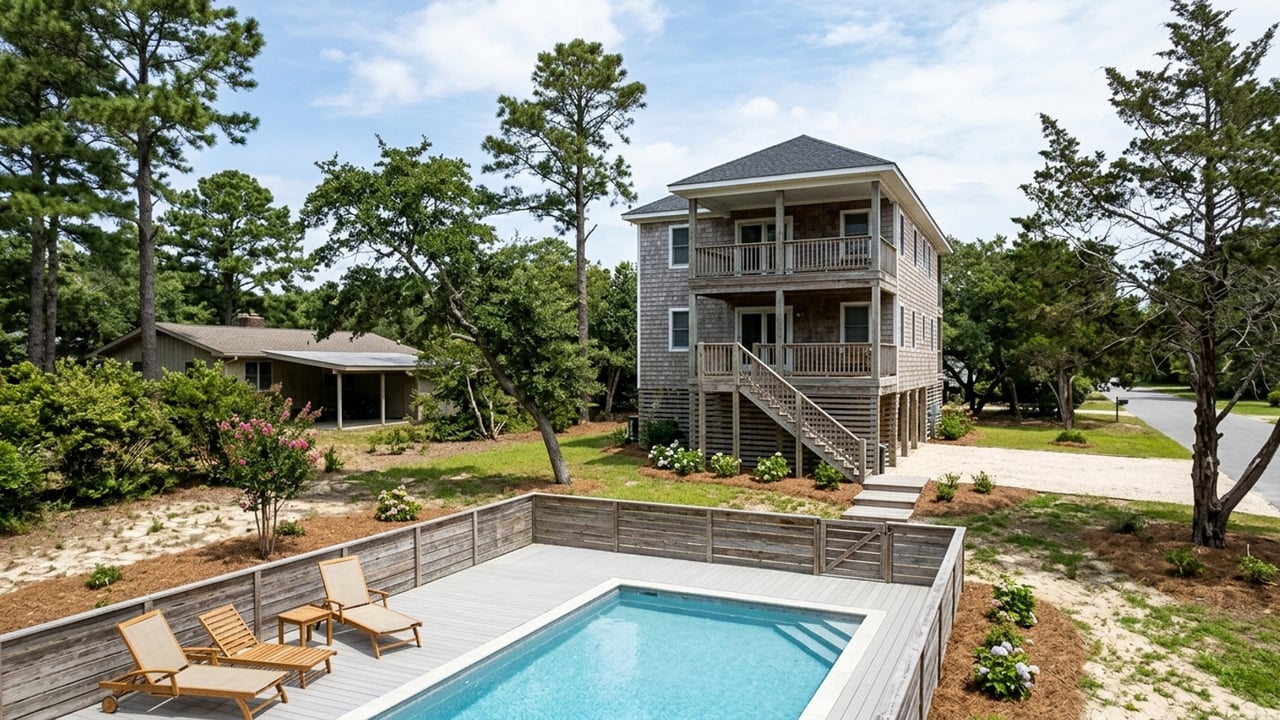
Buyers looking at properties in Dare County pay close attention to storm readiness and the condition of major systems. Selling a house on the coast means answering those structural and environmental questions upfront, before a buyer's inspector or insurer does it for you.
When buyers can't verify the age of a roof or the status of a septic system, they lower their offers to cover the perceived risk. Preparing a home for this market is largely about providing the documentation that prevents those automatic price reductions.
Key takeaway
In Southern Shores, the projects most likely to protect your sale price are the ones that remove buyer discounts: roof and wind upgrades, flood records, and a clean septic report. Recent buyers have been paying roughly $26,600 under asking on a median-priced home, making that gap the realistic target to close. If you have the budget for more, test any addition against the local price per square foot before you build.
Who this guide is for
You own a home in Southern Shores and are deciding which improvements, if any, to make before selling in the next year or two.
What increases home value in Southern Shores right now
Southern Shores homes recently sold at 96.8% of list price after a median 80 days on market, with 5.4 months of supply. This is based on 16 single-family sales over the 90 days ending September 30, 2026. That sale-to-list ratio means buyers demanded a roughly $26,600 discount on a median-priced home.
At this price point on the coast, buyers discount for unknowns: roof age, wind ratings, flood zones, septic conditions, unpermitted work. The value an owner can add before selling comes from removing those specific objections rather than installing new finishes. You can check our neighborhood guide to see how pricing behaves across different zones within the town.
How to decide which projects to do
You can narrow down your pre-listing project list by evaluating your home's current documentation and your timeline.
- Is your roof more than about 15 years old, or do you lack wind-rating paperwork for it? Start with roof and wind-resistance upgrades before spending on anything inside.
- Do you know your flood zone, and do you have an elevation certificate? If not, gather your flood zone and elevation records first, because a buyer's lender and insurer will ask.
- Are you listing within six months, or holding longer? A short timeline points to the objection-removing upgrades and pricing your home to protect its value. A longer hold makes adding square footage worth testing.
- Has the home been rented to vacationers? Gather your rental history and records, since investor buyers will value documented income differently than owner-occupants.
Always get a pre-listing inspection before choosing projects. That way you're fixing what a buyer's inspector would find, not what you're guessing needs attention.
Upgrades that remove buyer objections
These projects rarely show up in listing photos, but they actively shrink the discount buyers take during negotiations. Addressing insurance and storm risk is the most specific objection for an oceanfront-county home, followed closely by flood, septic, and rental records.
Buyers factor the cost of unknown repairs into their initial offers. Clear documentation for these coastal property systems removes their justification for coming in low.
Roof and wind-resistance upgrades
A roof is often the first thing a coastal buyer's inspector and insurer question. A new or recertified roof built to a recognized wind standard can lower the buyer's insurance quote, which supports your asking price. The NC Department of Insurance promotes the IBHS FORTIFIED Roof standard, noting that NC State research found homes with a FORTIFIED Roof had about 35% fewer claims after recent major hurricanes.
The North Carolina Insurance Underwriting Association (NCIUA), which manages the state's coastal Beach Plan, maintains a schedule of mitigation credits for policyholders. Ask your insurer which documented wind-mitigation features earn a premium credit, and get it in writing.
The honest downside: buyers rarely add the full cost of a new roof to their offer. What you mostly recover is the discount they would otherwise demand, and only if you can hand over the designation or mitigation paperwork.
Flood zone and elevation records
You can't change your flood zone, but you can remove the guesswork for the next owner. Locate or order an elevation certificate, and check your FEMA flood zone before you list. Ask your flood insurance agent whether your existing NFIP policy can be assumed by a buyer under Risk Rating 2.0, which can preserve a discounted rate.
Buyers may also ask about local mitigation efforts, like the large-scale beach nourishment project Southern Shores completed alongside Kitty Hawk, Kill Devil Hills, and Duck. This project is funded by a town-wide tax and is scheduled for a subsequent renourishment in 2027.
One catch worth knowing early: an elevation certificate can show a lower-than-hoped elevation. Once you have that number, you must disclose it, so order the certificate early enough to price around the answer.
Septic system inspection
Most homes in Southern Shores use private septic systems permitted through Dare County Environmental Health rather than a town sewer. A recent pumping and inspection report answers questions a buyer would otherwise discount for during their due diligence period. The county handles the permitting process, which involves an Improvement Permit, a Construction Permit, and a final Operations Permit.
Request your septic permit, including the approved bedroom count, and any repair records from the county office in Nags Head.
What you give up is flexibility if the permitted bedroom count is lower than the number of rooms you're using as bedrooms. If that's the case, you can't advertise the extra rooms as bedrooms, and that can cost more value than any upgrade adds.
Rental history and records
Organized rental income, booking calendars, and occupancy-tax records turn a cash-flow claim into hard evidence for investor buyers. Dare County levies a 6% occupancy tax on private residences rented to transients for 15 days or more in a calendar year. That creates a paper trail of rental activity you can present to buyers, with returns documented monthly.
If the home is currently rented, list any bookings that fall after a likely closing date and confirm how they'd be handled.
The downside is that heavy rental use shows up as wear, and owner-occupant buyers may discount for it. Future bookings can complicate showings, and the town limits vacation cottages to a maximum of 14 overnight occupants.
Upgrades that add space or appeal
Projects buyers can easily see are worth the investment only when the payback math works. Coastal construction costs often outpace the value these additions bring to the final appraisal, and in a softer market that gap gets wider.
Every cosmetic or structural addition carries the risk of costing more than it returns. Test any planned upgrade against local square-foot values before hiring a contractor.
Adding square footage
At the recent $316 median price per square foot, a 300-square-foot addition maps to about $94,800 of value on paper. Get an all-in per-square-foot quote for the addition and compare it to that local median to see if the project makes financial sense. This benchmark mixes homes of all sizes and ages, so checking comparable sales in your specific area is a smart next step.
Confirm lot coverage and setback limits with the town before designing an addition or larger deck. The town's primary residential district caps lot coverage at 30 percent, with 15-foot side and 25-foot rear setbacks, along with a mandatory minimum lot width of 100 feet.
Coastal construction quotes can easily exceed the median price per square foot. When building costs outpace the local median, the addition loses money on paper.
Kitchen and bathroom updates
A dated but sound kitchen can often be priced around more cheaply than it can be rebuilt. Minor refreshes like paint, hardware, and fixtures cost less, and full remodels rarely pay for themselves entirely. Published remodeling surveys for the South Atlantic region show that minor updates recoup a larger share of their cost than major ones.
A midrange bath remodel in the Raleigh metro recoups about 80% of its job cost. That specific figure applies to Raleigh rather than Southern Shores, but the regional trend holds on the coast.
Buyers at this price point often plan to redo kitchens to their own taste. A full remodel finished just before listing can recoup well under its cost.
Decks, siding and outdoor space
Salt air, sun, and wind age exterior wood and fasteners quickly on the Outer Banks. Replacing failing deck boards, rusted connectors, or worn siding addresses what inspectors flag and what buyers notice the moment they pull into the driveway.
The Town of Southern Shores requires building permits for residential construction and renovation, including an 'as-built' survey with lot coverage calculations before final approval. The process also requires an NC Power Permanent Project Number and a completed Residential Energy Efficiency Certificate. Ask the town for the permit history on your property, and confirm any past work was permitted.
Budget certainty is what you give up. Structural rot found mid-project can turn a cosmetic job into a larger repair you then have to finish or disclose.
Pricing your home to protect its value
A median 80 days on market and 5.4 months of supply mean buyers have options and time to compare. Only 6.3% of homes, about 1 of the 16 recent sales, sold above list price. Pricing above recent comparable sales tends to add time on market and leads to a later price cut rather than a higher final payout.
You can review our Southern Shores market trends page for more detail on how pricing behaves in current conditions. Presenting your objection-removing paperwork alongside a realistic list price protects your equity better than testing a high number.
Next steps before you list
Start by scheduling a pre-listing inspection, pulling your permit history, and requesting your county septic permit. Gather your roof, flood, and rental paperwork to have it ready for potential buyers. From there, you can evaluate space or appeal projects using the payback test against local square-foot values.
Cameron Griggs Real Estate can review which projects make financial sense for your specific home and walk you through the selling process and cash offers.
At a glance
- Median sale price: $830,854 (all homes, 90 days ending 2026-09-30; based on 16 sales, so treat as a rough guide)
- Single-family median sale price: $830,919, down 1.7% year over year (90 days ending 2026-09-30; the same 16 sales, since every recent sale was a house)
- Year-over-year change in median sale price: -2% (all homes, 90 days ending 2026-09-30; based on 16 sales)
- Median price per square foot: $316 (all homes, 90 days ending 2026-09-30; based on 16 sales)
- Median days on market: 80 (all homes, 90 days ending 2026-09-30; based on 16 sales)
- Sale-to-list ratio: 96.8% (all homes, 90 days ending 2026-09-30; based on 16 sales)
- Homes sold above list price: 6.3%, about 1 of 16 sales (all homes, 90 days ending 2026-09-30)
- Months of supply: 5.4 (all homes, 90 days ending 2026-09-30)
- Homes for sale: 29 (all homes, inventory for the 90 days ending 2026-09-30)
- Homes sold: 16 (all homes, 90 days ending 2026-09-30)
Southern Shores home value FAQs
What is the median home price in Southern Shores, NC?
The median sale price is roughly $830,854 for all homes, based on 16 sales over the 90 days ending September 30, 2026. Because of the small sample size, buyers should treat this as a rough guide. You can check our housing market page for more detailed trends.
Are home prices dropping in Southern Shores?
The median sale price dipped 2% year over year for all homes over the 90 days ending September 30, 2026 (based on 16 sales). Single-family homes saw a 1.7% drop during the same window (also based on those 16 sales, since every recent sale was a house). This represents a modest dip that gives buyers some room to negotiate, rather than a steep slide.
Do homes in Southern Shores increase in value over time?
Long-term trends generally show appreciation, though current 90-day figures offer only a short-term snapshot of the market. Buyers can check the FHFA house price index for the Kill Devil Hills micropolitan area to see historical regional data.
Does solar increase home value in Southern Shores?
Owned solar panels can add appeal, and North Carolina excludes 80% of the appraised value of a solar energy electric system from the local property tax base. The Town of Southern Shores requires building permits and inspections for installation, including an Operation Permit and a Residential Energy Efficiency Certificate. If you have solar panels, confirm whether they are owned or leased, since a lease must be transferred or paid off.
How many homes sold in Southern Shores recently?
There were 16 homes sold in Southern Shores over the 90 days ending September 30, 2026, all of which were single-family properties. During that same period, there were 29 homes for sale. This small sample size means a few sales can shift the median numbers noticeably.
What is the hardest month to sell a house in Southern Shores?
Sales volume fluctuates seasonally on the Outer Banks, and late fall or winter can be quieter for closings. For example, single-family closed sales in Southern Shores rose in June 2026 but showed a year-to-date decline by September. Sellers should compare their listing timing against any summer rental bookings to minimize disruptions.
Do I need a permit to renovate a home in Southern Shores?
Yes, the town requires building permits for residential construction and renovation, including decks, additions, roofing, and siding. The process involves a formal inspection sequence, a foundation survey, and an 'as-built' survey before final approval. Work begun without a permit can trigger a fee of twice the normal permit cost.
Sources
- Redfin: Data Center
- Town of Southern Shores: Building Permit Requirements
- Municode: Southern Shores Zoning Ordinance
- Town of Southern Shores: Water and Septic
- NC Department of Insurance: FORTIFIED Roof Grants
- NCIUA: Schedule of Mitigation Credits
- FEMA: NFIP Risk Rating 2.0 FAQs
- Town of Southern Shores: Beach Nourishment Project
- Dare County: Occupancy Tax
- JLC Online: Cost vs Value 2025 Raleigh, NC
- NC General Assembly: G.S. 105-275 Property Tax Exemptions
- Island Free Press: Outer Banks Home Sales Reports