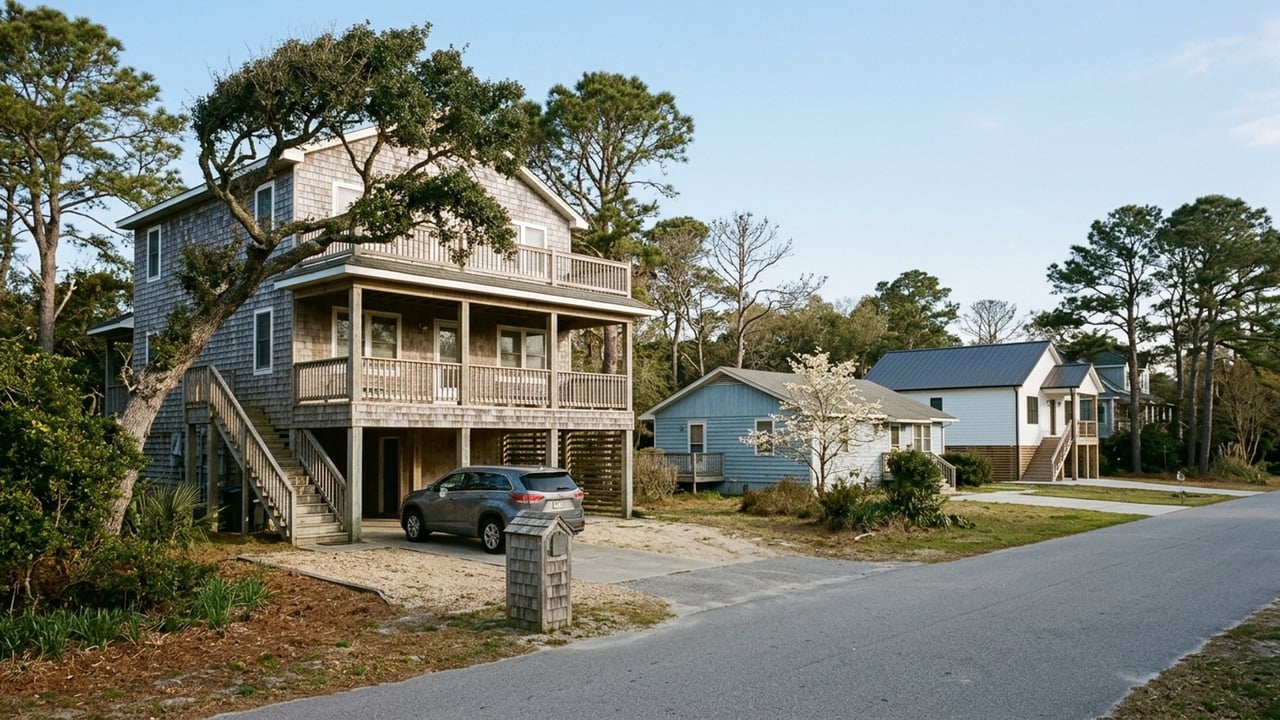
Southern Shores is a small market. The median home here sold for around $830,854 in the 90 days ending September 30, 2026, closing at 96.8% of asking price after roughly 80 days on the market. That's 16 single-family sales, so treat the numbers as a directional guide, not a precise benchmark. What they do tell you clearly: the typical gap between asking and sale price was about $27,500. One percentage point of commission on a median-priced sale costs around $8,300. That gap is worth more than three of those points.
The rate you agree to matters. But it matters less than how well your listing agent can close that gap.
Key takeaway
In Southern Shores, commissions are negotiable and spelled out in your listing agreement. The seller pays the listing side from sale proceeds and decides how to respond to any request to cover the buyer's agent. Each percentage point represents that same fixed cost at the recent median, but the spread between asking and closing price moves more money than a point or two of commission. Choose the agent whose pricing and negotiation plan you trust, not just the lowest rate. If you already have a buyer or you are prioritizing certainty over top dollar, a flat-fee listing or a cash offer is the lower-cost route.
Who this guide is for
This guide is for sellers in Southern Shores who need to work out what commission to agree to, how to handle a buyer's agent fee, and what they will net at closing.
What a commission costs on a Southern Shores home
The rate you agree to is just one part of the math. North Carolina law sets no standard commission, and every rate is negotiated. A one-point difference between two proposals is real money, but it's a known, fixed cost. The final sale price is the bigger lever on your net proceeds.
What each percentage point costs
At the recent median price, every point of commission on a typical Southern Shores sale runs about $8,300. For illustration only: a 5% combined commission is roughly $41,500, and a combined rate one point higher is about $49,900.
The median rests on just 16 sales, and your home's price may sit well above or below it. Run the math on your own likely price, and see prices by zone on the neighborhoods page.
Why the sale price matters more than the rate
A median-priced home selling at the median ratio closed about $27,500 under its asking price. That gap is worth more than three points of commission. Pricing, presentation, and negotiation are what a listing fee is supposed to buy you.
In a market where the typical home sits for around 80 days, an overpriced listing that needs multiple cuts costs more than a point of commission. You can review Southern Shores market trends for more detail on how long homes are taking to sell.
No agent can promise to close that gap, and a higher fee doesn't guarantee a higher price. Ask each agent for their own recent sale-to-list ratio and days-on-market record in Southern Shores, and judge the actual evidence.
Who pays realtor fees when you sell in Southern Shores
How buyers and sellers handle real estate fees shifted in late 2024. Every fee comes down to the written agreements signed by both parties, so understanding the structure helps you evaluate offers clearly.
The listing side
The seller pays the listing brokerage under the terms of the listing agreement. That fee is taken from the sale proceeds at closing and shown on the settlement statement. The commission goes to the brokerage, which then pays the agent under its own arrangement.
Only what's written in the listing agreement counts. Services or rate reductions promised verbally aren't enforceable, so get everything on paper.
The buyer's agent
Under the practice changes that took effect in August 2024, buyers sign a written agreement with their own agent before touring homes. A buyer may then ask the seller to cover some or all of that fee in their offer.
With 5.4 months of supply and only about 1 of 16 recent sales closing above asking, buyers have negotiating power. Expect these requests, and decide your answer before offers arrive. Saying no doesn't make the cost disappear: the buyer either pays their agent directly or adjusts the offer downward. Compare offers on what you net, not on who pays which fee.
North Carolina agency disclosures
North Carolina agents must provide the "Working with Real Estate Agents" disclosure at first substantial contact. This form explains your representation options. If one firm represents both buyer and seller, it operates under dual or designated agency, which can affect the fee conversation. Under dual agency, one firm represents both sides, which limits the advice each side receives. Ask how the firm handles in-house buyers before you sign anything.
Full-service, reduced-fee and flat-fee listings
Your choice of listing approach depends on how much time you have and whether you already know someone who wants the house. Each option trades cost for service.
Full-service listing
This covers pricing strategy, preparation advice, photography, and marketing, along with showings for buyers who may not be local, offer negotiation, due diligence and repair negotiation, and coordination with the closing attorney. It's the right fit for a seller who wants to protect the sale price in a slow market.
Full service costs the most. Ask for the marketing plan, price-review schedule, and services in writing before you sign, or you have nothing to hold anyone to. If you'd rather have speed and certainty than top dollar, review the selling process and cash offers route instead of listing on the open market.
Reduced-fee listing
You can negotiate a lower rate from a traditional agent or hire a discount brokerage. Every point you save keeps that same per-point amount in your pocket on a typical sale.
Something usually gets cut in return, often open houses, price reviews, or negotiation time. Those are the elements that matter most when homes sit. Ask exactly which services are dropped before you agree.
Flat-fee MLS listing
An upfront fee gets the home on the MLS. The seller handles showings, offers, and negotiation. North Carolina closings go through an attorney, but the attorney closes the deal and doesn't negotiate it for you. This works well for a seller who already has a buyer or has been through the process before.
The tradeoff: you'll be negotiating directly with the buyer's agent, and the buyer-agent fee question lands on you with no one in your corner.
Other costs Southern Shores sellers pay at closing
Commissions are the largest line item on your settlement statement, but several other taxes and fees come out of your proceeds before you see a check. These costs are finalized by your closing attorney.
North Carolina excise tax
The state excise tax is $1 per $500 of the sale price, customarily paid by the seller. Dare County also levies an additional local land transfer tax of $1 per $100 of consideration, making the combined transfer-tax cost in Southern Shores higher than in most of the state. On a sale at the recent median, the state portion alone is $1,600.
The tax is calculated on the full sale price, not your net. Price reductions are the only thing that lower it.
Closing attorney and payoff fees
Seller-side attorney or deed-preparation fees come out of your proceeds at closing. The mortgage payoff and any lender release fees are also deducted directly from the sale funds. Fees vary by firm, so ask the closing attorney for a written quote and request a payoff statement from your lender early.
Property tax proration
The seller pays property taxes for the portion of the year they owned the home, credited to the buyer at closing. Both Dare County and Town of Southern Shores rates apply to the calculation. The prorated amount shows as a credit or a charge depending on whether the year's bill has already been paid, so confirm it with the closing attorney once you have a closing date.
Net proceeds: a closing illustration
Using a 5% combined commission on an $800,000 sale for illustration only: that's $40,000, plus the $1,600 state excise tax, leaving $758,400 before attorney fees, tax proration, and the mortgage payoff. Agreeing to 1% toward a buyer's agent shifts that net by $8,000, so you can weigh competing offers on those figures.
This is an illustration, not a quote or advice. Your real numbers come from your listing agreement, the accepted offer, and the attorney's settlement statement.
Selling a home that's in a vacation rental program
Many properties on the Outer Banks operate as short-term rentals, and when you sell one, the existing management agreement and future bookings add another layer to the transaction. Handling these contracts correctly prevents disputes with both the buyer and the tenants.
Future bookings and the Vacation Rental Act
North Carolina's Vacation Rental Act requires advance rent paid by the tenant to be transferred to the new owner within 30 days of the sale. For vacation rentals that end more than 180 days after the new deed is recorded, however, advance rents must be transferred back to the tenant unless the buyer agrees in writing to honor them. A buyer may want those bookings or may not, and either choice affects your marketing and your contract.
Bookings running past closing can narrow your pool to buyers willing to honor them. Ask your listing agent and rental manager how the bookings will be disclosed and handled before you list.
Rental management fees versus your listing commission
The management company's percentage of rental income is not part of the sale commission and ends only under that agreement's own terms. Buyers planning to rent the property will ask about town rental and occupancy rules, including Southern Shores' limit of 14 overnight occupants for a vacation cottage. Check with the Town of Southern Shores on these rules so you're prepared when the question comes up.
Some management agreements require notice or charge fees to exit. Read the termination clause before you choose a closing date.
How to negotiate your listing commission
Getting the right arrangement on paper means asking direct questions before you sign. A structured approach makes it easier to compare your options fairly.
Compare written proposals from two or three agents
Ask each agent for the rate, the full list of services, and how the rate changes if they also find the buyer or if you offer buyer-agent compensation. Comparing in writing turns a vague question into a concrete choice.
The lowest rate on paper can come with the thinnest service. Look at what each proposal includes, not just the percentage.
Ask for each agent's pricing plan and track record
Ask for a recommended list price backed by comparable sales, a schedule for reviewing the price if showings slow down, and their own recent sale-to-list results in Southern Shores. This ties directly back to the fact that the price gap moves more money than the rate. Track records built on a handful of sales can mislead, so ask how many transactions the numbers rest on.
Read the term, protection period and cancellation clauses
Before you sign, cover the listing length, the protection or carryover period that can trigger a commission after the listing ends, and the terms for ending early. A long term or a broad protection clause can tie you to one agent longer than you'd like. Negotiate these terms as hard as you negotiate the rate, and review the best real estate agent in Southern Shores page for help finding representation.
How to decide what to agree to
If you already have a buyer lined up, such as a neighbor, a tenant, or a past renter, you may not need marketing at all. Start with the flat-fee MLS listing and reduced-fee listing sections. If you can carry the house through a slow sale and want to protect your price, read about why the sale price matters more than the rate and consider a full-service listing.
If speed and certainty matter more than top dollar, compare the cash offer route linked in the full-service section. Before you list, decide how you will respond if an offer asks you to cover part of a buyer's agent fee, and read the buyer's agent section and the closing illustration so you can compare offers on your net. If the home is in a vacation rental program with future bookings, read the vacation rental section before you sign a listing agreement.
At a glance
- Median sale price: $830,854, down 2% year over year (all homes, 90 days ending Sept 30, 2026; based on 16 sales, so treat it as a rough guide)
- Single-family median sale price: $830,919, down 1.7% year over year (single family, 90 days ending Sept 30, 2026; all 16 sales in the window were single-family homes)
- Median days on market: 80 (all homes, 90 days ending Sept 30, 2026; 16 sales)
- Median sale-to-list ratio: 96.8% (all homes, 90 days ending Sept 30, 2026; 16 sales)
- Homes sold above list price: 6.3%, about 1 of 16 sales (all homes, 90 days ending Sept 30, 2026)
- Months of supply: 5.4 (all homes, 90 days ending Sept 30, 2026)
- Homes for sale: 29 (all homes, 90 days ending Sept 30, 2026)
- Median price per square foot: $316 (all homes, 90 days ending Sept 30, 2026; 16 sales)
Southern Shores real estate commission FAQs
Is 3% a standard realtor fee in North Carolina?
No rate is set by law, and all rates are negotiated. At the recent median price, 3% comes to roughly $24,900. Don't assume any local average applies to your transaction.
Are realtors still charging high combined rates after the 2024 rule changes?
Combined rates are negotiated case by case, and listing and buyer-side fees are now set in separate agreements. Per Clever Real Estate's 2026 agent survey, the national average total real estate commission is 5.46% of the sale price. This is up slightly from the 2024 low of 5.32% but still below the traditional 6% benchmark.
Can a seller's offer to pay the buyer's agent still appear on the Outer Banks MLS?
No. The Outer Banks Association of REALTORS adopted policy changes effective August 17, 2024, prohibiting offers of buyer-broker compensation from being published in the MLS. Compensation is instead negotiated directly between the listing broker and buyer's broker outside the MLS, with the listing broker retaining sole discretion in setting it.
When is the commission paid when you sell a house in North Carolina?
The commission is paid at closing from the sale proceeds by the closing attorney and itemized on the settlement statement. Nothing is owed upfront under a standard listing, but check your own agreement to be sure.
Do I owe a commission if my listing expires and the buyer comes back later?
It depends on the protection period in your listing agreement and whether the home is relisted with another firm. Read your agreement's carryover clause and the list of protected buyers to understand your obligations.
What disclosures must a seller provide in North Carolina?
North Carolina's Residential Property Disclosure Act requires sellers to complete a disclosure statement covering the property's condition. Failure to provide the form can give the buyer grounds to cancel the contract.
Sources
- Redfin: Data Center
- NAR Settlement FAQ
- NC Real Estate Commission Publications
- NC Real Estate Commission Bulletins
- NC State Bar Authorized Practice Advisory Opinion 2002-1
- NC General Statutes Chapter 105
- Dare County Tax Rates
- NC General Statutes Chapter 42A
- Town of Southern Shores Code of Ordinances
- Outer Banks Association of REALTORS Release
- Clever Real Estate 2026 Survey
- NC General Statutes Chapter 47E